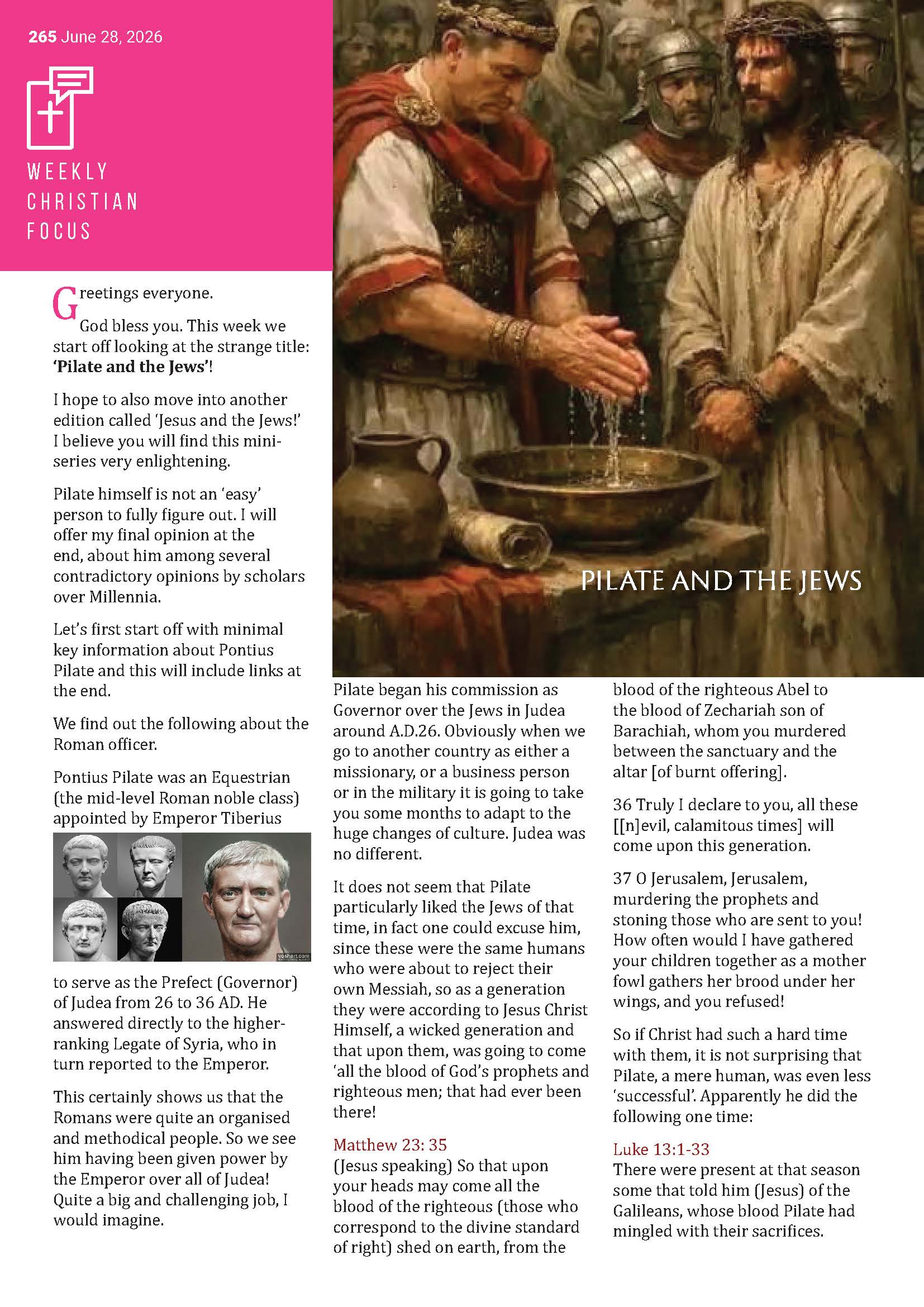
This article examines the role of Pontius Pilate in the trial and crucifixion of Jesus Christ, arguing that Pilate has often been misunderstood. After briefly outlining Pilate’s position as Roman governor of Judea and his difficult relationship with the Jewish leadership, the article focuses on the Gospel accounts, particularly Luke 23 and John 19.
A repeated pattern emerges throughout the trial. The Jewish leaders accuse Jesus, Pilate personally examines Him, repeatedly declares Him innocent, and attempts to release Him. Each declaration is met with increasingly aggressive demands from the religious leaders and the crowd until Pilate finally yields to political pressure and authorizes the crucifixion.
The article emphasizes that Pilate defended Jesus several times and wanted to release Him, while Jesus Himself acknowledged that Pilate’s authority had been given “from above” and that those who handed Him over bore the greater guilt. Although Pilate ultimately failed through fear and political pressure, the author suggests his responsibility should be understood within God’s sovereign plan for redemption.
The article concludes by reviewing the uncertain historical traditions surrounding Pilate’s later life, including reports that he became a Christian, committed suicide, or simply disappeared from reliable history. While acknowledging there is no historical proof, Jerry Finch expresses the personal belief that Pilate eventually came to faith in Christ, pointing to God’s mercy and the influence of the events surrounding the crucifixion.