

In this life, timing seems to be very important. Some things can change in a matter of seconds, and can be the difference between life and death, success or failure. Here are some examples to consider.
King Saul was ordered by God to execute a mission. King Saul was to completely destroy one of Israel’s enemies. God knew of the wickedness that they had committed, and He wanted to eliminate it at its roots. God ordered King Saul to eliminate the Amalekites, including eradicating all their animals and possessions. King Saul had a difficult time obeying God’s command. Upon his return, he is met by the prophet Samuel. King Saul proudly proclaims that he’s obeyed the commandment of the Lord. Samuel asks Saul three times if he obeyed the commandment of the Lord, if I recall correctly, before Saul admits that he didn’t actually obey. As a result, Saul lost the anointing that God had bestowed upon him, as the king of Israel, as well as the promise that his descendants will be on the throne – all because of being late in executing what God assigned for him to do.

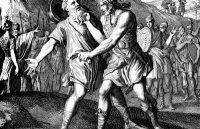
Another example to consider from the Bible is King David. After fleeing from his own son Absalom who tried to overthrow him, and later finding out that that very same son was killed against his wishes, King David appoints Amasa to be the general and commander of his army. Amasa’s first assignment is to meet up in three days with the army at a certain place. Amasa, perhaps overjoyed at this appointment of duty, Amasa got a little too involved in minutia and was late as a result.
His tardiness could have been why Amasa was careless. When he was confronted by Joab, who came to greet him, Amasa didn’t notice the sword Joab held in his hand. Joab promptly removed this usurper to his position, and Amasa died a disgrace there, pulled off to the side of the road and covered with a blanket. His carelessness and tardiness cost him his life, and his position.
Our next example is that of five foolish virgins who were invited to a wedding feast. There were five wise virgins who had prepared by buying oil for their lamps, and though they did fall asleep while waiting for the bridegroom to arrive, when the bridegroom arrived, quickly arose, trimmed their lamps, and went out to greet him. The five foolish virgins who did not prepare and so had no oil for their lamps said, “Can we have some of your oil for our lamps?”
They responded, “No. We only have enough for ourselves. Why don’t you go and buy some? Then you’ll have what you need. Hopefully, we will see you there.” So the five foolish virgins had to go buy oil for their lamps, and, due to their lack of foresight and preparation, they missed out on being let in to the wedding feast, and even the opportunity to be married to the bridegroom.

Another example from the Bible is that of the Apostle Paul. In the later chapters of the Book of Acts, Paul mentions that the Holy Ghost, through many people and places, warns him not to go to Jerusalem. He is given a multitude of warnings, and is warned that he will be bound and given over to the Gentiles.
Yet, the Apostle Paul proclaims that he will go to Jerusalem, even if he has to die. Finally, Jesus Himself says, “Okay, Paul. You’ll be a witness for me in Rome, just as you were in Jerusalem.” Christ Himself makes this proclamation. A possibility is that, if the Holy Spirit was warning Paul not to go, this was Christ’s declaration – via the Holy Spirit – that it wasn’t God’s highest and best will for the Apostle Paul to go to Jerusalem.
In the end, Paul makes up his mind, though he’s exhorted, cajoled, directed, and guided by many disciples along the way to not go up to Jerusalem. He decides that he’s going to go. Christ tells him, you are going to be a great witness for Me in Rome.
The Apostle Paul is in Jerusalem approximately two years in, Rome for approximately two years, and then he gives his life as a martyr for Christ. This is approximately 67 or 68 A.D. Now suppose Christ’s highest will for him was for him to add even more witnesses and souls for Christ to his already extensive resume. Just two years after that, the temple was destroyed.
Think of the effect Paul could have had at that time on the Jewish community, as well as the world, had he not gone up to Jerusalem. The potential impact that he could have had for those four years, proclaiming the Gospel to the rest of the world after the temple was destroyed, and helping them to be able to relate to Christ as the Messiah. Think what of a change that could have brought to the whole world, had he made a different choice. I guess we’ll find out on the other side. We’ll never know.
And our final example is the Apostle Peter’s late lunch. Peter was waiting for lunch, and, perhaps to kill time while waiting, he went up to the top of the house. There he got a revelation. He saw a vision from the Lord of a large sheet being let down from Heaven. Inside of it were all kinds of animals and creatures and a proclamation, “Rise, Peter. Kill and eat.”
“Not so, Lord. I’ve never had anything unclean or unholy enter my mouth.” Then the sheet was taken back up to Heaven. Then, the sheet would be lowered back down, and the vision repeated itself, with the same command from Christ. This happened three times. Peter is up on the roof of a house waiting, and the Lord tells him that there would be three men from another city coming to see him, and that he’s to go with them without any question. And, immediately after that, they show up.
So, the apostle Peter goes with them, and ends up leading the Roman centurion Cornelius , his family, and relatives to the Lord. The Holy Spirit comes down upon them, and he sees that God’s Spirit is also reaching the Gentiles, and not just the Jews. A major revolution took place with Peter and the Church, from a seemingly “late” lunch. Trust God‘s timing.